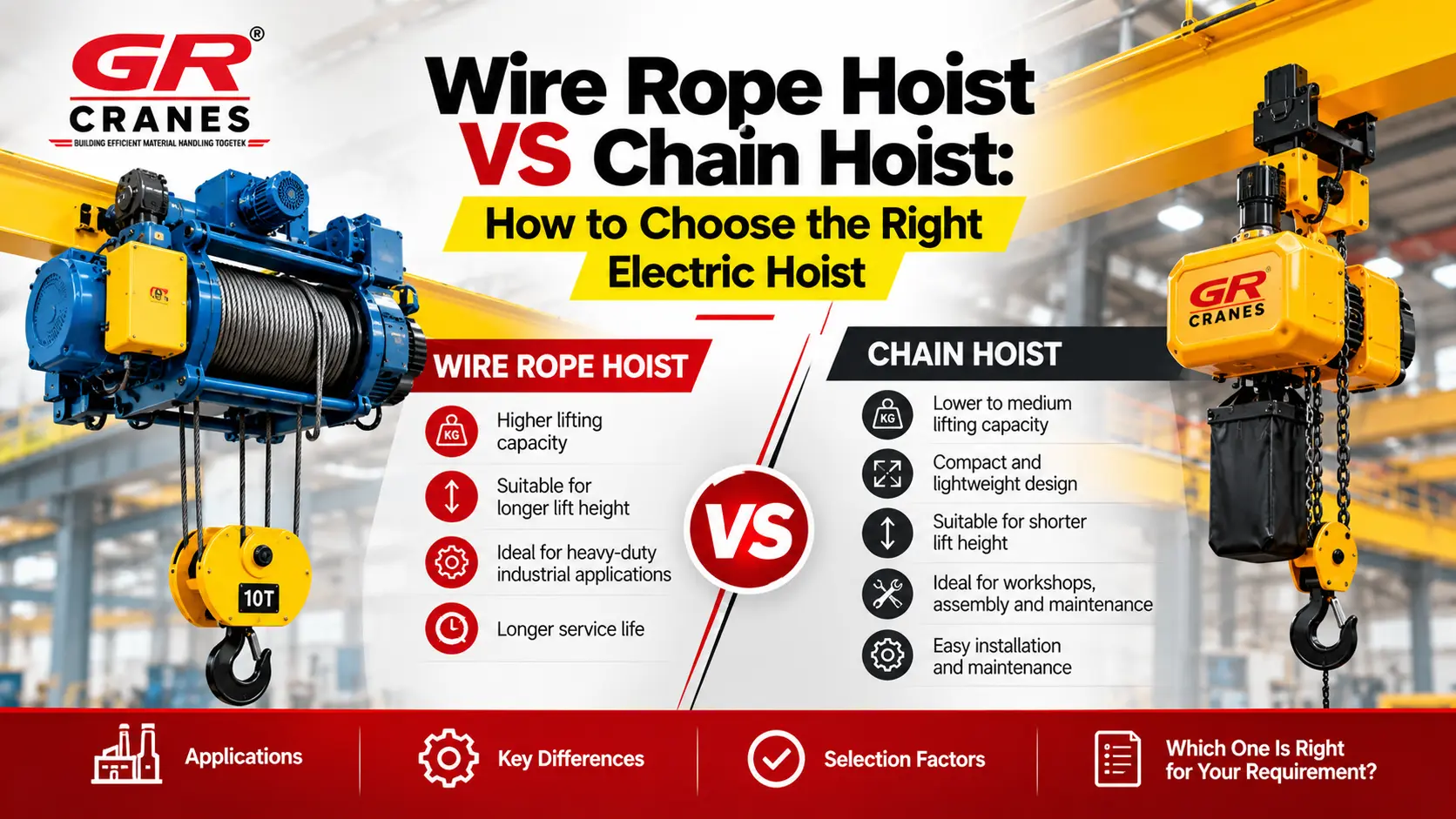
Choose a wire rope hoist for higher capacity (GR range 0.5 to 20 ton), longer lifts and heavier duty. Choose a chain hoist for lighter loads (GR range 0.5 to 2 ton), workshops and intermittent use, where compact size and low maintenance matter. Match the hoist to load, lift height, duty class and how often it works.
Key takeaways
- Capacity is the first filter: above 2 ton, a wire rope hoist is the practical choice in GR's range; up to 2 ton, either may work.
- Chain hoists are compact and economical for workshops. Wire rope hoists are built for longer lifts, heavier duty and wider capacity.
- Duty class decides durability. Our chain hoist is rated M3/M4; for heavier duty, ask for a wire rope hoist specified to your duty class.
- Both can be fitted to a crane trolley, a monorail or a fixed beam, and both are available in flameproof versions.
Ask a maintenance head which hoist to buy and you will hear strong opinions on both sides. The truth is simple: neither is better in general. Each fits a different job. This guide compares the two types on the factors that decide the answer in an Indian plant: capacity, lift height, speed, duty, maintenance, environment and cost, using the ranges of the hoists we build in Ludhiana.
What is the difference between a wire rope hoist and a chain hoist?
Both are electric hoists that lift a load with a motor and a brake. The difference is the lifting element. A wire rope hoist winds a steel wire rope onto a grooved drum. A chain hoist runs a load chain over a pocket wheel and collects the slack chain in a chain container. That single difference shapes capacity, lift height, speed, noise and upkeep.
Wire rope hoist vs chain hoist: side-by-side comparison
| Factor | Electric wire rope hoist | Electric chain hoist |
|---|---|---|
| GR Cranes capacity range | 0.5 to 20 ton | 0.5 to 2 ton |
| Lift height | Per customer requirement; longer lifts suit the drum | 3, 6, 9 or 12 m standard, customisable |
| Lifting speed | Selected for the application | 2.5 to 7.2 m/min, model dependent |
| Duty class | Equivalent to IS 3938 | M3 / M4 |
| Brake | Built-in fail-safe brake | Electromagnetic disc brake |
| Size and weight | Larger, heavier unit | Compact and light |
| Main wear item | Wire rope, drum grooves, brake | Load chain, pocket wheel, brake |
| Typical use | Crane trolleys, heavy workshops, long lifts | Workshops, warehouses, light assembly |
Figures above come from the specification tables of our electric wire rope hoist and electric chain hoist. Final values depend on the model and your requirement.
When should you choose a wire rope hoist?
- The load is above 2 ton, up to 20 ton in our range.
- You need a long lift height, or smooth, quiet lifting with fine control.
- The hoist will run on a crane trolley under an EOT bridge, since most medium and heavy cranes use wire rope hoists. See our wire rope electric hoist range.
- Duty is medium to heavy, with many lifts per hour.
- You want a design in line with IS 3938 for electric wire rope hoists.
When should you choose a chain hoist?
- The load is 2 ton or less, as in light assembly, maintenance and machine loading.
- Space is tight and you need a compact, light unit.
- Use is intermittent: a few lifts per hour rather than continuous cycles.
- Lift height is moderate, up to about 12 m.
- You want simple servicing with a visible, easily replaced load chain.
How do duty class and environment affect the choice?
Duty class describes how hard a hoist works: lifts per hour, share of lifts near full load and hours of operation. A chain hoist rated M3/M4 is built for light to medium duty. If your hoist will work most of every shift in a foundry or steel yard, specify a wire rope hoist specified for that duty class. Dust, heat and humidity matter too. Both types are built with protection class and insulation suited to industrial use, and our chain hoist is IP54/IP55 with Class F insulation.
In explosive atmospheres, such as chemical, pharma and oil and gas plants, a standard hoist is not allowed. Our flame proof hoist is available as an electric wire rope or chain hoist from 0.5 to 20 ton, with Ex-rated components.
How do the two compare on maintenance and cost?
Both need regular inspection of the brake, limit switch, hook and lifting element. Wire rope is inspected for broken wires, kinks, corrosion and reduced diameter; chain is inspected for elongation, wear and corrosion at links. Neither is maintenance-free. A chain hoist is usually less expensive to buy at low capacity and simple to service. A wire rope hoist costs more at low capacity but is the only practical option at higher capacity, and gives smoother, longer-lasting service in heavy duty. Prices vary with capacity, lift height, speed, controls and duty, so request a quote for your requirement; our article on EOT crane price in India lists the factors. Use the maintenance and inspection checklist to schedule checks for either type.
Can you use either hoist on a crane, a monorail or a fixed beam?
Yes. Both can be mounted on a trolley under a single girder EOT crane, on a trolley on a monorail beam, or fixed to a beam. On a crane, the hoist and trolley form the lifting and cross-travel system; the parts are explained in our guide to EOT crane parts and components.
A quick selection guide
- Load: over 2 ton, choose wire rope. Up to 2 ton, continue.
- Duty: continuous or heavy, choose wire rope. Intermittent, continue.
- Lift height: very long, choose wire rope. Up to about 12 m, either works.
- Space and budget: tight space and low load, choose chain.
- Hazardous area: specify a flameproof version of either.
If you are unsure, send your load, lift height, duty and shed details through our contact page and our engineers will recommend a hoist and, where needed, the matching crane.
Frequently asked questions
What is the difference between a wire rope hoist and a chain hoist?
A wire rope hoist lifts with steel wire rope wound on a drum; a chain hoist lifts with a load chain over a pocket wheel. Wire rope hoists suit higher capacity and longer lifts, chain hoists suit lighter, compact applications.
Which is better, a wire rope hoist or a chain hoist?
Neither is better in general. Choose a wire rope hoist for higher capacity, longer lifts and heavier duty, and a chain hoist for lighter loads, tight spaces and intermittent use.
What capacity does a chain hoist support?
GR Cranes' electric chain hoist covers 0.5 to 2 ton, with standard lift heights of 3, 6, 9 and 12 m that can be customised. Above that, a wire rope hoist is the practical choice.
What capacity can an electric wire rope hoist lift?
GR Cranes builds electric wire rope hoists from 0.5 to 20 ton, with lift height and speeds selected to the customer's requirement and shed dimensions.
Can a hoist be used in a hazardous area?
Only if it is built for it. A flame proof hoist uses Ex-rated components for areas with flammable gas, vapour or combustible dust. GR Cranes offers flame proof wire rope and chain hoists from 0.5 to 20 ton.
How often should a hoist be inspected?
Operators should check the hook, rope or chain, brake and limit switch before each shift. Maintenance staff should inspect more fully on a weekly and monthly schedule, and a competent person annually.
Sources and standards
- IS 3938: Specification for electric wire rope hoists (Bureau of Indian Standards)
- IS 2266: Steel wire ropes for general engineering purposes (Bureau of Indian Standards)
- IS 3177 and the manufacturer's manual for inspection and replacement criteria (Bureau of Indian Standards)
- GR Cranes & Elevators electric wire rope hoist, electric chain hoist and flame proof hoist specifications from grcranes.com, checked 2026-10-28
About GR Cranes & Elevators: ISO-certified EOT crane manufacturer in Focal Point, Ludhiana, Punjab, operating since 1998 and an authorized EOT crane builder for the Bajaj Group of Companies. Serving Ludhiana, Chandigarh, Mohali, Dera Bassi, Ambala and pan-India installations. Phone +91-98140-85890, info@grcranes.com.