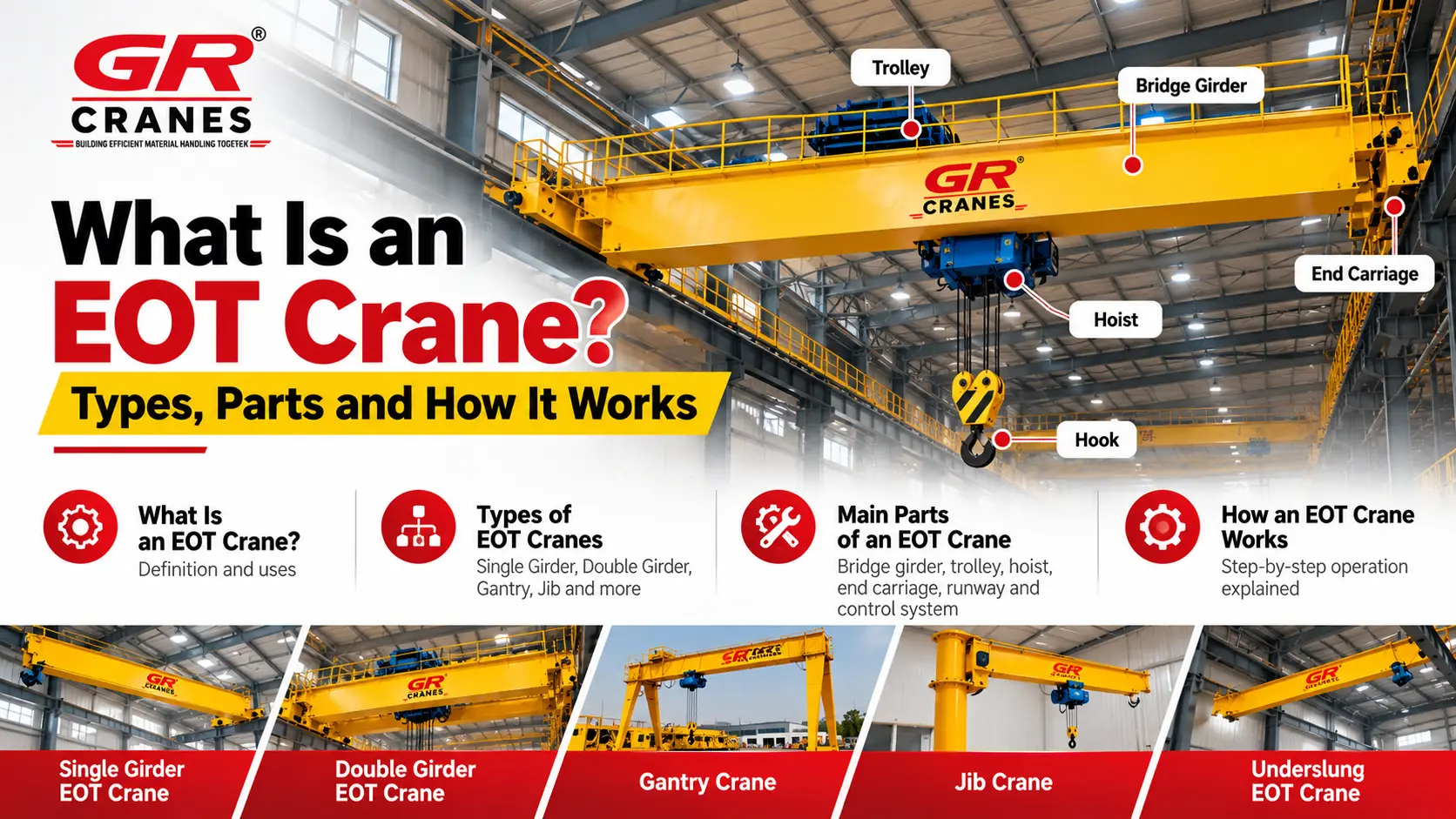
An EOT crane (electric overhead travelling crane) is a bridge crane that runs on rails high up in a building. A hoist on a trolley lifts the load, the trolley moves across the bridge, and the bridge travels the length of the shed, so one operator can place a load anywhere on the floor below.
Key takeaways
- An EOT crane has three motions: hoisting (up and down), cross travel (across the bridge) and long travel (along the shed).
- Main types are single girder, double girder and underslung. Single girder suits lighter duty; double girder suits heavy lifts and long spans.
- GR Cranes builds single girder cranes from 0.5 to 20 ton, double girder cranes up to 30 ton and underslung cranes up to 12.5 ton, custom-engineered to the shed and duty.
- Choose by load, span, lift height and duty class (how hard and how often it works), not by tonnage alone.
Walk into almost any steel, auto-component, textile or engineering plant around Ludhiana and you will see a crane running above the shop floor on two steel rails. That is an EOT crane. It frees the floor, moves heavy material faster than a forklift and keeps people out from under the load path. This guide explains in plain language what an EOT crane is, how it works, the main types, what it is made of and how to think about choosing one. It is written by the team that designs and fabricates these cranes at Focal Point, Ludhiana.
What is an EOT crane and how does it work?
An EOT crane is a crane whose main structure, the bridge, spans the width of a building and rides on rails fixed to the building columns or to a separate structure. A trolley carries a hoist along the bridge. Because the whole assembly is electric and travels overhead, the name is electric overhead travelling crane. In everyday plant language it is also called a bridge crane or overhead crane.
The crane works through three independent motions, each driven by its own electric motor with a built-in brake:
- Hoisting: the hoist winds wire rope on a drum (or runs a chain) to raise and lower the hook.
- Cross travel (CT): the trolley carrying the hoist moves across the bridge from one side of the shed to the other.
- Long travel (LT): the bridge itself moves on the runway rails along the length of the shed.
Combine the three and the hook can reach any point in the rectangle covered by the runway. The operator controls it from the floor with a pendant push-button station, with a radio remote, or from a cabin on larger cranes. Power reaches the moving crane through trailing cables, a drag chain, shrouded bus bars or a DSL conductor system such as our SafeTrack DSL bus bar.
What are the main types of EOT crane?
Cranes are grouped mainly by how the bridge is built and where the hoist runs.
| Type | Construction | Typical use | GR Cranes range |
|---|---|---|---|
| Single girder | One bridge girder; hoist hangs below it | Workshops, light to medium duty, lower headroom cost | 0.5-20 ton, span 3-40 m |
| Double girder | Two bridge girders; trolley runs on top | Heavy lifts, long spans, high duty, more hook height | Up to 30 ton, span up to 30 m |
| Underslung | Bridge hangs from the building's roof structure | Where floor columns cannot carry a runway | Up to 12.5 ton, span up to 18 m |
Related overhead and floor-mounted lifting equipment is often grouped with EOT cranes. A gantry or goliath crane runs on rails at ground level and works outdoors or in yards. A pillar mounted jib crane serves a single work cell. A monorail hoist moves loads along a fixed beam path.
If you are deciding between the two common bridge types, read our detailed comparison of single girder vs double girder EOT cranes.
What are the main parts of an EOT crane?
Every EOT crane, whatever its size, is built from the same families of components:
- Bridge girder(s): the horizontal beam or beams that span the shed.
- End carriages: the wheeled assemblies at each end of the bridge that run on the rails.
- Hoist and trolley: the lifting unit with motor, gearbox, drum, rope or chain, and hook block, mounted on a trolley.
- Drives and brakes: geared motors for each motion, with fail-safe brakes that hold the load when power is cut.
- Electrical panel and power feed: contactors, protection and the cable, drag chain or bus bar system that powers the crane.
- Controls and safety devices: pendant or radio control, limit switches, overload protection, emergency stop and buffers.
We cover each one in detail, with what to inspect and what wears first, in our guide to EOT crane parts and components.
What capacity and duty class do you need?
Capacity (the safe working load, or SWL) is the heaviest load the crane may lift. Duty class describes how hard the crane works: how many lifts per hour, how often it lifts near its full load and for how many hours a day. Two 10-ton cranes can be very different machines if one lifts five times a shift and the other runs continuously in a steel yard.
Our cranes are designed to Indian standards IS 3177 and IS 807, with duty classes equivalent to M3, M5, M7 and M8 available on our single girder range. Tell the manufacturer your real lifting pattern, not only the heaviest load. It is the single biggest input to the design and to the price, as we explain in EOT crane price in India.
Where are EOT cranes used?
Wherever material is heavy and the floor is busy: steel and re-rolling mills, foundries, automotive and auto-component plants, textile and engineering units, power and cement plants, warehouses, railway workshops, ports and shipyards. In the Ludhiana-Punjab belt, the most common requests we see are for 3 to 20 ton single girder cranes in fabrication and machining shops, and double girder cranes in heavier steel and foundry operations. Our completed projects span Punjab, Haryana, Jammu and Kashmir, Himachal Pradesh and Uttarakhand.
How do you choose the right EOT crane?
- Load: the heaviest load and the typical load, including any lifting beam or tooling weight.
- Span and lift height: measure the distance between runway rails and the hook height you need above the floor.
- Duty class: lifts per hour, hours per day, and how often you lift near full load.
- Building: headroom, column strength and whether a runway already exists.
- Environment: heat, dust, corrosive air or explosive atmosphere, which may call for special hoists such as a flame proof hoist.
- Controls and power feed: pendant or radio, and how the moving crane will be powered.
Send these six inputs through our contact page and our engineers will recommend a configuration. Because each crane is built to the customer's load, span and site, there is no fixed catalogue price; we quote after reviewing your requirement.
How do you keep an EOT crane safe?
Safety depends on the right protective devices and on routine inspection. Review the seven essential safety features to look for, then follow a structured maintenance and inspection checklist with daily, monthly and annual checks.
Frequently asked questions
What does EOT stand for in an EOT crane?
EOT stands for electric overhead travelling. It describes an electrically powered crane whose bridge travels on elevated rails above the work area, carrying a hoist that lifts and moves loads across the floor.
What is the difference between an EOT crane and an overhead crane?
In India the terms are used interchangeably. An EOT crane is an electrically driven overhead bridge crane. Overhead crane is the general international term; EOT is the common industrial name.
How does an EOT crane work?
Three motors drive three motions: the hoist raises and lowers the load, the trolley moves it across the bridge, and the bridge moves along the runway. Together they position the hook anywhere under the crane.
What are the types of EOT crane?
The main types are single girder, double girder and underslung. Single girder suits lighter duty, double girder suits heavy loads and long spans, and underslung cranes hang from the roof structure where floor columns cannot carry a runway.
What is the capacity range of an EOT crane?
Capacity depends on the build. GR Cranes builds single girder cranes from 0.5 to 20 ton, underslung cranes up to 12.5 ton and double girder cranes up to 30 ton, each custom-engineered to the application.
Which standards apply to EOT cranes in India?
Design and construction commonly follow IS 3177 for electric overhead travelling cranes and IS 807 for the structural portion. Your site must also meet the Factories Act and applicable state rules on lifting machines.
Sources and standards
- IS 3177: Code of practice for electric overhead travelling cranes and gantry cranes other than steel work cranes (Bureau of Indian Standards)
- IS 807: Code of practice for design, manufacture, erection and testing (structural portion) of cranes and hoists (Bureau of Indian Standards)
- GR Cranes & Elevators product specifications (single girder, double girder, underslung) from grcranes.com, checked 2026-10-28
- Factories Act, 1948 and applicable state Factories Rules on lifting machines (verify exact section references with a safety officer)
About GR Cranes & Elevators: ISO-certified EOT crane manufacturer in Focal Point, Ludhiana, Punjab, operating since 1998 and an authorized EOT crane builder for the Bajaj Group of Companies. Serving Ludhiana, Chandigarh, Mohali, Dera Bassi, Ambala and pan-India installations. Phone +91-98140-85890, info@grcranes.com.