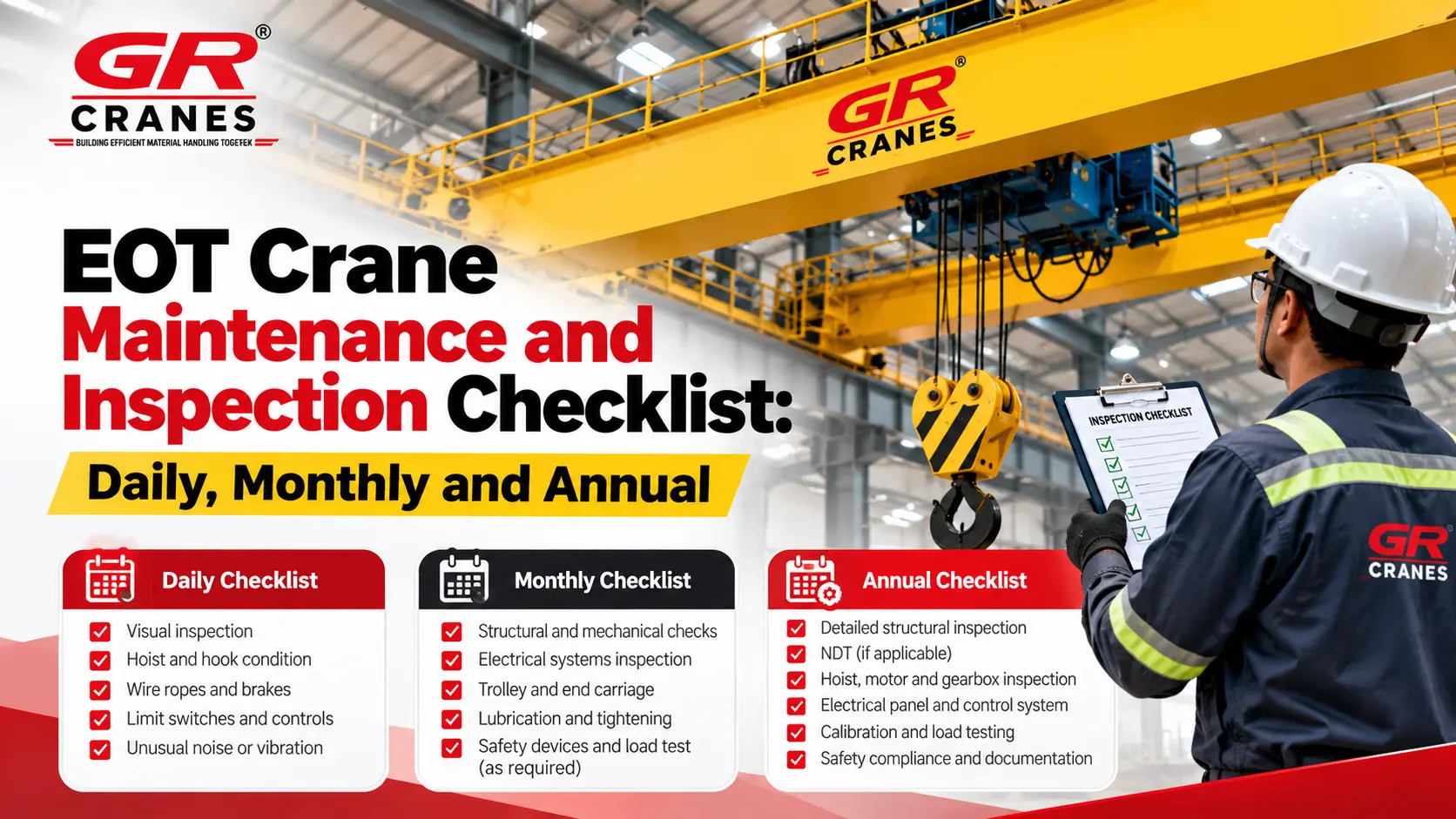
An EOT crane needs a daily pre-shift check by the operator, weekly and monthly inspections by maintenance staff, and a detailed annual inspection with load test by a competent person. Check hooks, wire rope, brakes, limit switches, emergency stop, structure, wheels, rails and electrical panels, and take the crane out of service on any critical defect.
Key takeaways
- Operators do a pre-shift check; maintenance staff handle weekly and monthly tasks; a competent person does the annual inspection and load test.
- Hook, wire rope, brakes and limit switches are the safety-critical items. Defects here mean stop the crane.
- Keep a dated logbook. It is your evidence for audits, insurers and statutory inspections.
- Frequencies below are a practical starting point. Confirm them against IS 3177, the OEM manual and Indian factory-law requirements for your site.
A well-maintained EOT crane runs for decades. A neglected one fails at the worst time, and a failure with a suspended load injures people. Most breakdowns are not sudden: worn wire rope, drifting brakes, loose fasteners and failed limit switches show warning signs for weeks. This checklist, written by the team that builds and services cranes at Focal Point, Ludhiana, shows what to check and how often. Use it with your crane's own manual.
Important: this is general guidance. Inspection frequency, record keeping and load testing are governed by IS 3177, the manufacturer's manual and the Indian Factories Act and state rules that apply to your site. Where they differ from this page, follow them.
How often should an EOT crane be inspected?
| Interval | Who | Scope |
|---|---|---|
| Daily (before each shift) | Crane operator | Visual and function checks, no tools |
| Weekly | Maintenance technician | Lubrication, rope, wiring, brake adjustment, track |
| Monthly | Maintenance team | Structure, gearbox, overload device, limit switch test |
| Quarterly | Maintenance team | Functional tests of all safety devices, wheel and rail wear |
| Annual | Competent person / OEM | Full inspection, NDT where needed, load test, certificate |
These intervals are a practical baseline used across industry. Heavy-duty cranes in steel, foundry or cement plants should be inspected more often.
What should be checked daily on an EOT crane?
- Walk the area: clear the floor path and check nothing is stored under the load path.
- Hook: check for cracks, twisting, throat opening and a working safety latch.
- Wire rope or chain: look for broken wires, kinks, flattening, corrosion and correct seating on the drum.
- Brakes: lift a light load a short distance, hold and confirm it does not drift; test hoist, cross travel and long travel.
- Limit switches: confirm the upper limit stops the hook before it hits the drum.
- Emergency stop and pendant or radio remote: test that every function responds and stops.
- Unusual noise, vibration or smell during the first run.
- Record the check and any defect in the logbook before starting work.
What does a weekly and monthly EOT crane maintenance checklist include?
- Lubricate gearboxes, wheel bearings, couplings and rope as per the OEM chart.
- Check gearbox oil level and look for leaks.
- Inspect wheels and flanges for wear, and rails for gaps, misalignment and loose clips.
- Check bolts on end carriage joints, trolley and hoist mounting.
- Inspect the girder, welds and platforms for cracks, deformation and corrosion.
- Inspect the festoon cable, drag chain or DSL bus bar collectors for wear and arcing.
- Check contactors, panels and terminals for heat marks and loose connections.
- Test the overload device and calibrate load indicators.
- Check motor insulation and brake coil condition.
For the protective devices themselves, read our guide to seven essential EOT crane safety features; this checklist tells you how often to test them.
What happens in an annual EOT crane inspection?
The annual inspection is a detailed examination of every structural, mechanical and electrical component by a competent person, with a record of findings. It usually includes measuring wheel and rail wear, checking girder camber and deflection, inspecting hook and rope for replacement criteria, testing all brakes and protective devices and performing a load test at the proportion of rated load specified by the standard and statutory rules.
When should you stop using an EOT crane immediately?
- The brake fails to hold a load, or the load drifts.
- A limit switch or emergency stop does not work.
- Broken wires, a kink or a bird-caged rope section.
- A cracked or opened hook, or a missing safety latch.
- Visible cracks in girders or welds.
- Sparking, burning smell or exposed live conductors.
- Unusual noise from gearbox or wheels.
Tag the crane out of service, isolate the main supply and call a qualified technician. Do not run the crane 'just to finish the shift'.
What records should you keep?
Keep a logbook for each crane with daily check sheets, maintenance actions, parts replaced, the annual inspection report and load test certificate, operator training records and incident reports. These records help during factory inspector visits, insurance claims and resale.
Should you use an annual maintenance contract (AMC)?
An AMC suits plants without in-house crane engineers. It schedules inspections, supplies genuine spares and keeps records in order. GR Cranes & Elevators supports the cranes it builds from Ludhiana across Punjab, Haryana and the Chandigarh tricity belt. Send the crane make, capacity and location through the contact page to discuss service. If you are planning a new crane, compare the single girder and double girder options first.
Frequently asked questions
How often should an EOT crane be inspected?
Operators should check the crane before every shift, maintenance staff should inspect weekly and monthly, and a competent person should carry out a detailed annual inspection with a load test. Heavy-duty cranes need more frequent checks.
What should be in a daily EOT crane checklist?
Check the hook and latch, wire rope or chain, brakes, upper limit switch, emergency stop and pendant, and listen for abnormal noise. Record the check in a logbook and report any defect before lifting.
Who can carry out an EOT crane inspection in India?
Daily checks are done by the trained operator. Periodic and annual inspections must be done by a competent person as defined under the applicable rules, often with the manufacturer or an approved inspector. Check your state factory rules.
What is preventive maintenance for an EOT crane?
It is scheduled inspection, lubrication, adjustment and part replacement carried out before failures occur. It covers gearboxes, brakes, wheels, wire rope, electrics and safety devices, and reduces downtime and accident risk.
When should wire rope on an EOT crane be replaced?
Replace it when broken wires, corrosion, kinks, flattening or diameter reduction exceed the limits in the standard or the OEM manual. Any bird-caging or core protrusion means immediate replacement.
Is a load test required every year?
Load testing requirements are set by IS 3177 and statutory rules, and often apply after installation, major repair and at defined periodic intervals. Confirm the exact requirement for your state and industry.
Does GR Cranes provide maintenance and spare parts?
GR Cranes & Elevators supports the cranes it builds from Ludhiana. Contact the team with your crane details to discuss inspection, spares and annual maintenance.
Sources and standards
- IS 3177: Code of practice for electric overhead travelling cranes and gantry cranes other than steel work cranes (Bureau of Indian Standards)
- IS 807: Code of practice for design, manufacture, erection and testing (structural portion) of cranes and hoists (Bureau of Indian Standards)
- Factories Act, 1948 and applicable state Factories Rules on lifting machines (verify exact section references with a safety officer)
- Crane inspection frequency guidance reviewed from industry maintenance manuals, 2026-10-27; intervals vary by source and must be confirmed against IS 3177
About GR Cranes & Elevators: ISO-certified EOT crane manufacturer in Focal Point, Ludhiana, Punjab, operating since 1998 and an authorized EOT crane builder for the Bajaj Group of Companies. Serving Ludhiana, Chandigarh, Mohali, Dera Bassi, Ambala and pan-India installations. Phone +91-98140-85890, info@grcranes.com.