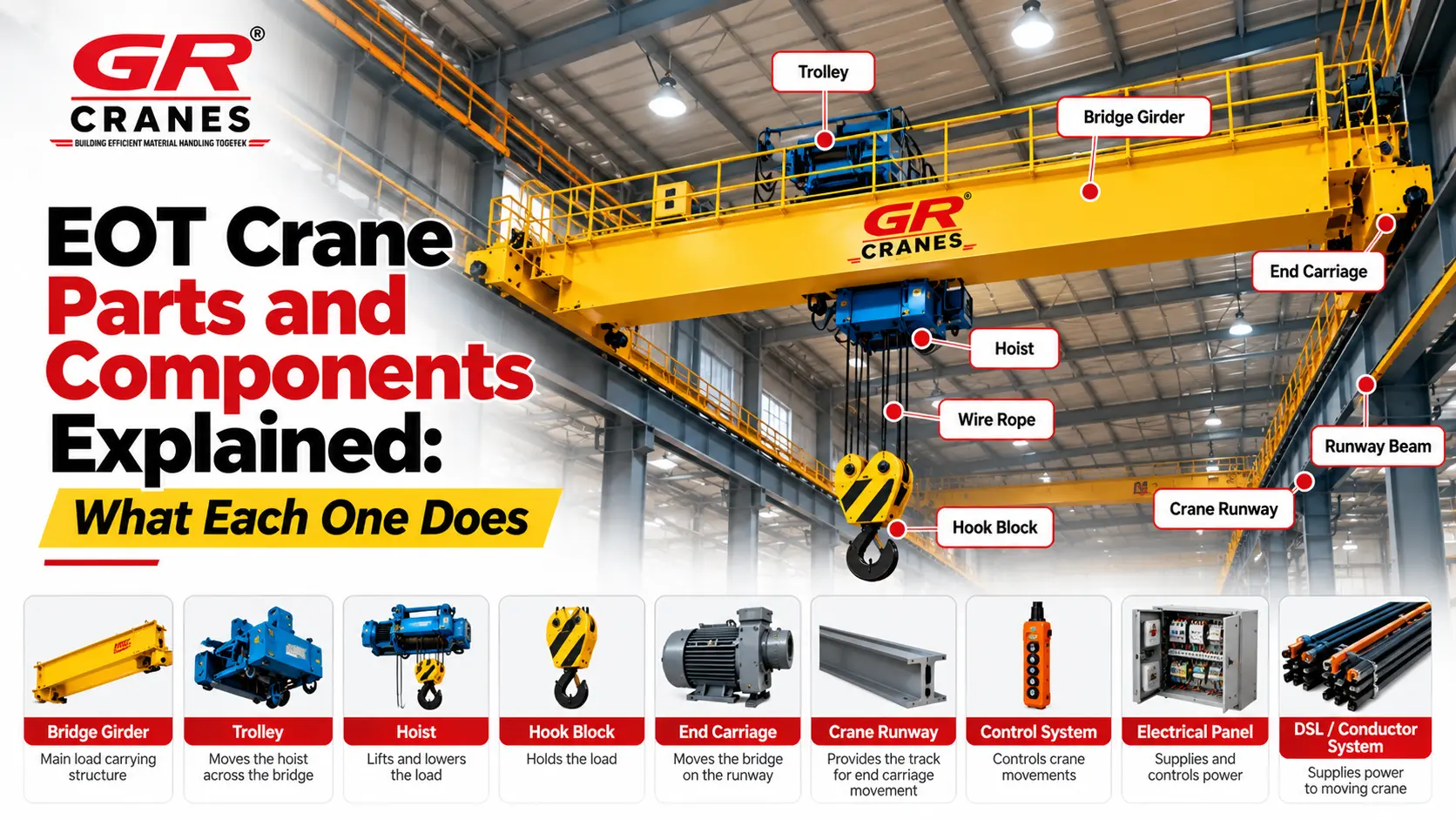
The main parts of an EOT crane are the bridge girder, end carriages with wheels, hoist and trolley, drive motors with gearboxes and brakes, the electrical panel and power feed, and the safety devices such as limit switches and overload protection. Together they lift, traverse and travel the load safely.
Key takeaways
- Six part families: structure (girder, end carriages), travel (wheels, rails), lifting (hoist, rope, hook), drives (motor, gearbox, brake), electrics and controls, and safety devices.
- Wire rope, brake linings, wheels and limit switches wear first and should be inspected most often.
- Brakes and limit switches are safety-critical. Do not run a crane with either faulty.
- Always give the manufacturer the crane's serial number or capacity and span when you order spares, so parts match.
Search for EOT crane parts and you find long lists with little explanation. This guide works through every major component in the order the load path runs, from the hook back to the building: what it does, what typically wears, and what to look at when you inspect. It is written for plant engineers, maintenance supervisors and buyers who want to understand a crane well enough to specify it, maintain it and order the right spare.
What are the main parts of an EOT crane?
An EOT crane has dozens of components, but they fall into six families. The table gives the overview; the sections below explain each family.
| Part family | Key components | What it does | What wears or fails first |
|---|---|---|---|
| Structure | Bridge girder(s), end carriages, platforms | Carries the trolley and load | Weld cracks, corrosion, deflection |
| Travel | Wheels, axles, bearings, runway rails | Moves crane and trolley | Wheel flange wear, rail misalignment |
| Lifting | Hoist, drum, wire rope or chain, hook block, hook | Raises and lowers the load | Wire rope, hook latch, rope guide |
| Drives | Motors, gearboxes, couplings, brakes | Powers each motion and holds the load | Brake lining, gear oil, couplings |
| Electrics and controls | Panel, contactors, pendant or radio, power feed | Switches and controls power | Contactors, cables, pendant buttons |
| Safety devices | Limit switches, overload limiter, buffers, emergency stop | Prevents over-travel and overload | Limit switch contacts, calibration drift |
What is the bridge girder and what are end carriages?
The bridge girder is the main horizontal beam. A single girder crane has one girder with the hoist hanging below it. A double girder crane has two girders with the trolley running on rails on top, which gives more hook height and suits heavier lifts and longer spans. Girders are typically fabricated from rolled sections or box-section plate and welded, and are designed to limit deflection under load.
End carriages (also called end trucks) are the wheeled assemblies bolted to each end of the girder. They carry the wheels, the long travel drive and the buffers. A complete single girder crane consists of one girder, two end carriage assemblies, one hoist with trolley and one electrical panel with field cables. To compare the two bridge types in depth, see single girder vs double girder EOT crane.
What are the wheels and rails for?
Wheels carry the full crane load onto the runway rails and guide the crane along them. Crane wheels are usually flanged and made from forged or cast steel, and run on bearings in the end carriage. Look for flange wear, flat spots and uneven wear between the two ends of the crane, which signals rail misalignment or a skewing crane. Runway rails need regular checks for gaps, joint wear and loose clips.
What does the hoist do and what is inside it?
The hoist is the lifting unit. Inside it sit the hoisting motor, a gearbox, the rope drum, a brake and the limit switch, with the rope running to the hook block. The hoist mounts on a trolley that crosses the bridge. Two main hoist types exist:
- Electric wire rope hoist: a rope winds on a grooved drum. It covers a wide capacity range and long lifts. GR Cranes builds electric wire rope hoists from 0.5 to 20 ton.
- Electric chain hoist: a load chain runs over a pocket wheel. It is compact and suits lighter duty. Our electric chain hoist covers 0.5 to 2 ton.
For choosing between them, read wire rope hoist vs chain hoist. The hook is forged, with a safety latch that must be present and working. The wire rope is the most inspected single item on the crane: check for broken wires, kinks, flattening, corrosion and diameter reduction, and replace it to the standard or the manufacturer's manual.
What are the motors, gearboxes and brakes?
Each motion has its own geared motor. On GR cranes these are squirrel cage induction motors with built-in fail-safe brakes, so the brake applies automatically when power is removed. The gearbox reduces motor speed and multiplies torque. We use hardened ground gears for quiet running and long life, and correct oil level and clean breathers are the simplest way to protect them.
Brakes deserve special attention. A hoist brake must hold the load with no drift. Brake linings wear with every stop, so check air gap, lining thickness and for oil contamination at each inspection. Variable frequency drives (VFDs) are an option on many cranes for smooth acceleration and dual-speed running, and they reduce shock on brakes and gears.
What are the electrical parts and how is power supplied?
The electrical panel houses contactors, overload relays, transformers and protection. The operator station is a pendant push-button, an optional radio remote, or a cabin with master controller. Power reaches the moving parts in one of two places: along the runway to the crane (long travel), and along the bridge to the trolley (cross travel). Common methods are trailing cables or a drag chain, shrouded bus bars, or a DSL conductor system. We cover the safer, low-maintenance option on our SafeTrack DSL bus bar page. Inspect collectors for wear and arcing.
Which parts are safety devices?
- Limit switches: stop the hook before it hits the drum or trolley, and stop travel at the end of the runway.
- Overload limiter: prevents lifting beyond rated load.
- Buffers and end stops: absorb impact if limit switches fail.
- Emergency stop and main isolator: cut power immediately.
- Hook safety latch and warning devices: prevent load slippage and warn people below.
These parts are explained in detail in our guide to the seven essential safety features of EOT cranes. Test them on the schedule in the EOT crane maintenance and inspection checklist.
How do you order the right EOT crane spare parts?
Quote the crane's make or manufacturer, serial number, capacity, span and the part's position or photo. Parts such as wheels, couplings, brake linings and ropes are dimension-specific, and a near match can fail early or damage the crane. GR Cranes supports the cranes it builds from Ludhiana. Send your crane details through the contact page to discuss spares and service.
Frequently asked questions
What are the main parts of an EOT crane?
The main parts are the bridge girder, end carriages with wheels, hoist and trolley, drive motors with gearboxes and brakes, the electrical panel and power feed, and safety devices such as limit switches and overload protection.
Which EOT crane parts wear out first?
Wire rope, brake linings, wheels and limit switch contacts usually wear first. Gear oil, couplings and contactors also need regular attention. Inspect these on the daily, monthly and annual schedule.
What is an end carriage on an EOT crane?
An end carriage, or end truck, is the wheeled assembly at each end of the bridge girder. It carries the wheels and long travel drive and runs the crane along the runway rails.
What is the difference between a hoist and a trolley?
The hoist is the lifting unit with motor, drum, rope and hook. The trolley is the wheeled frame that carries the hoist across the bridge. Together they form the crane's cross travel and lifting system.
How do crane brakes work?
Most crane motors have a spring-applied brake that holds when power is off and releases when the motor is energised. This fail-safe design holds the load if power is lost. Brake linings and air gap need regular checks.
How do I order a spare part for my EOT crane?
Give the manufacturer the crane's serial number, capacity, span and a photo or dimensions of the part. Dimension-specific parts such as wheels, couplings and brake linings must match exactly.
Sources and standards
- IS 3177: Code of practice for electric overhead travelling cranes and gantry cranes other than steel work cranes (Bureau of Indian Standards)
- IS 807: Code of practice for design, manufacture, erection and testing (structural portion) of cranes and hoists (Bureau of Indian Standards)
- IS 2266: Steel wire ropes for general engineering purposes (Bureau of Indian Standards)
- GR Cranes & Elevators single girder crane configuration and drive specifications from grcranes.com, checked 2026-10-28
- Part-wear guidance consolidated from OEM maintenance practice; confirm limits against the manufacturer's manual and IS 3177
About GR Cranes & Elevators: ISO-certified EOT crane manufacturer in Focal Point, Ludhiana, Punjab, operating since 1998 and an authorized EOT crane builder for the Bajaj Group of Companies. Serving Ludhiana, Chandigarh, Mohali, Dera Bassi, Ambala and pan-India installations. Phone +91-98140-85890, info@grcranes.com.