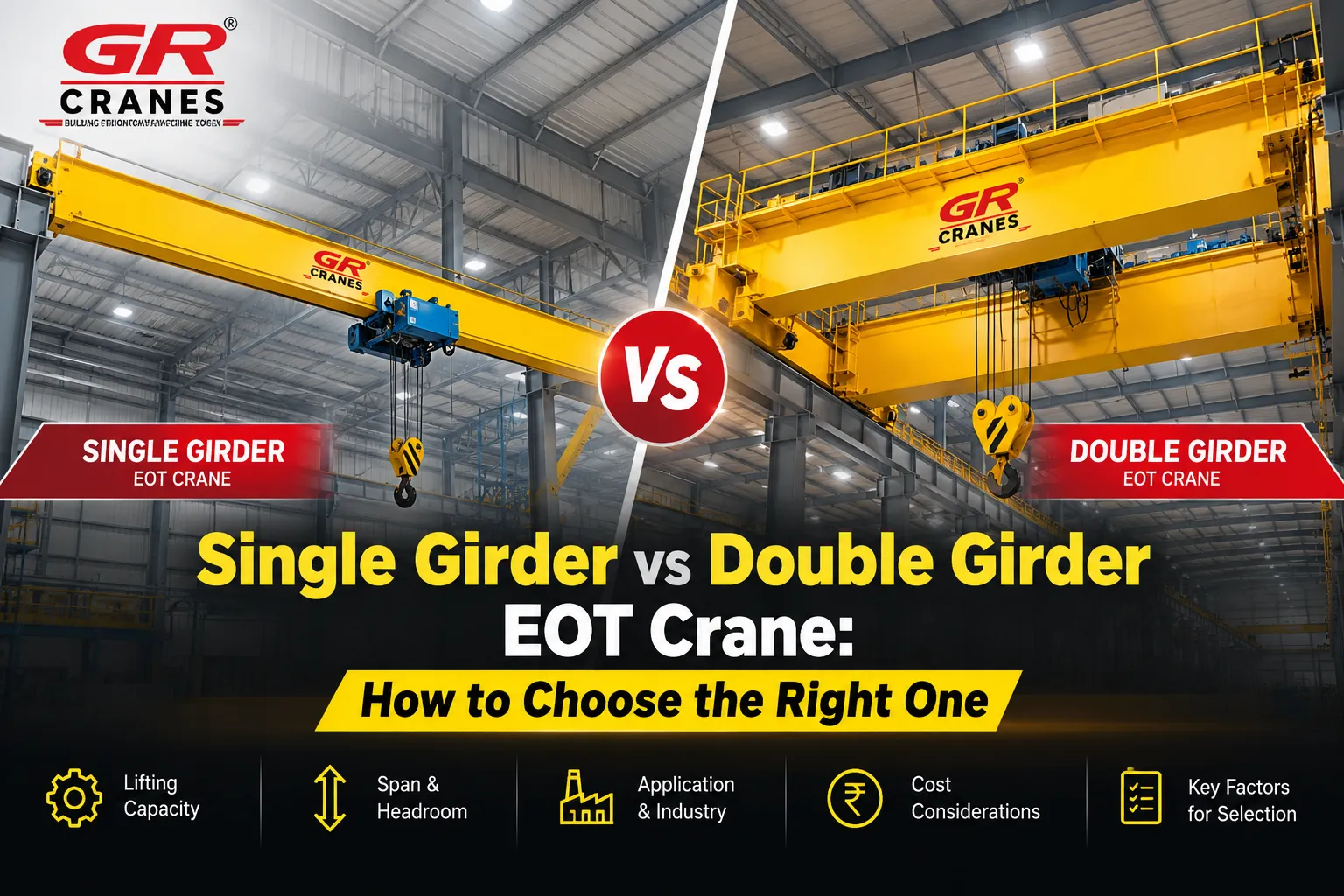
Single Girder vs Double Girder EOT Crane: How to Choose the Right One
A single girder EOT crane has one bridge girder and suits light to medium duty, spans up to about 40 m and loads up to 20 tonnes. A double girder EOT crane has two girders, gives more hook height and handles heavier, more frequent lifts. Choose by load, span, duty cycle and headroom, not price alone.
Key takeaways
- Single girder: one girder, lighter structure, lower cost, best for loads up to 20 t on light to medium duty.
- Double girder: two girders, higher hook height, walkway access, built for heavier and continuous duty.
- Duty class (how often and how hard you lift) matters more than the tonnage on the nameplate.
- Always size the runway, shed columns and power supply together with the crane.
Every plant manager buying an overhead crane meets this question early: one girder or two? The answer changes the price, the headroom you need, the runway design and how the crane behaves after ten years of daily use. This guide explains the difference between a single girder and a double girder EOT crane in plain terms, so you can brief a manufacturer with the right numbers. We build both types at our facility in Focal Point, Ludhiana, so the figures below come from real specifications, not brochure averages.
What is the difference between a single girder and a double girder EOT crane?
The difference is the number of bridge girders. A single girder EOT crane carries its hoist and trolley under one main girder. A double girder EOT crane runs two girders in parallel, with the trolley (crab) travelling on rails mounted on top of them. Everything else, including end carriages, wheels, drives and controls, follows from that choice.
A complete single girder crane (SGEOT) is made of one girder, two end carriage assemblies, one hoist with trolley and one electrical panel with field cables. A complete double girder crane (DGEOT) has two girders, two end carriage assemblies, a crab or trolley, a set of platforms and an electrical panel with field cables. The platforms are not a small detail: they give maintenance staff safe access to the machinery.
Single girder vs double girder EOT crane: side-by-side comparison
| Parameter | Single girder EOT crane | Double girder EOT crane |
|---|---|---|
| Bridge | One girder, hoist and trolley under it | Two girders, crab on top rails |
| Typical capacity (GR Cranes) | 500 kg to 20,000 kg | Up to 30 tonnes |
| Span (GR Cranes) | 3 m to 40 m | Up to 30 m |
| Hook height in a given building | Lower, hoist sits under the girder | Higher, hook travels between girders |
| Structure weight on runway | Lighter | Heavier |
| Duty class (IS 3177 / IS 807 equivalent) | M3, M5, M7, M8 as per specification | Medium to heavy duty, set per application |
| Maintenance access | From ground or ladder, hoist-mounted | Platforms along the bridge |
| Typical use | Workshops, fabrication, assembly lines, warehouses | Steel, foundry, heavy fabrication, continuous operation |
| Initial cost | Lower | Higher |
Specifications above are the ones published on our product pages; the exact values for your crane depend on span, lift height and duty and are confirmed in the quotation.
When should you choose a single girder EOT crane?
Choose a single girder crane when your loads are up to about 20 tonnes, lifts are not continuous and the building headroom is generous. It is the economical option for most machine shops, fabrication bays, warehouses and assembly lines.
- Loads are light to medium and the crane is used in shifts, not around the clock.
- You want the lowest initial cost and lighter loading on the building columns and runway.
- Spans are moderate and you do not need maximum hook height.
- You plan to control the crane by pendant push buttons from the floor, or by radio remote.
Our single girder range is described on the single girder EOT crane product page and in the single girder EOT crane manufacturer guide. If the shed is very low, also compare an underslung EOT crane, which hangs from the runway beam and can recover headroom.
When should you choose a double girder EOT crane?
Choose a double girder crane when loads are heavy, lifting is frequent, or you need the highest possible hook height in a fixed building. The two-girder bridge is stiffer, and the platforms make servicing safer.
- Loads approach or exceed the single girder range, up to 30 tonnes on our standard double girder design.
- The crane runs long hours, as in steel, foundry, cement or heavy fabrication plants.
- Lift height is critical because the hook travels between the girders and gains headroom.
- You want a cabin, anti-collision features or dual-speed control through a VFD.
On our standard double girder design, long travel and cross travel speeds go up to 20 m/min and hoisting up to 8 m/min. Single-speed motion is standard, with VFD optional, and dual-speed hoisting and long travel are available through a VFD. Details are on the double girder EOT crane product page and the double girder EOT crane manufacturer guide.
How do I choose between them? A four-question test
- What is the heaviest load, including slings and lifting beams? Add a margin and state it as the Safe Working Load (SWL).
- What is the span between runway rails and the lift height you need? Measure from the floor to the underside of the roof truss.
- How often and how hard will it lift? Count lifts per hour and the share of lifts at full load. This decides the duty class, from M3 for light duty up to M7 or M8 for severe duty.
- How will it be controlled and maintained? Pendant, radio remote or cabin, and whether staff need walkway access for servicing.
If the answers are light load, moderate span and shift-based use, a single girder crane is usually the right call. If two or more answers point to heavy, continuous or high-lift work, step up to a double girder.
What is duty class and why does it matter more than tonnage?
Duty class describes how intensively a crane works over its life, and Indian practice references IS 3177 for electric overhead travelling cranes and IS 807 for design and manufacture of the structural portion. A 10-tonne crane lifting twice a day and a 10-tonne crane lifting every two minutes are different machines: gears, brakes, wheels and structure are sized differently. State your duty cycle honestly when requesting a quote. Under-specifying duty is one of the most common reasons a crane wears out early.
Does the cost really differ?
Yes. A single girder crane has a lighter structure and lower initial cost. A double girder crane costs more because it uses two girders, more steel, platforms and a heavier end carriage. The better comparison is lifetime cost: a double girder in a heavy-duty application can outlast and out-perform a stretched single girder. Our guide to EOT crane price in India explains the cost drivers in detail.
What about the building and runway?
The crane is only part of the system. The runway beams, columns, foundation and power feed must carry the crane's wheel loads and travel. Share building drawings with your manufacturer before finalising the design. Our team in Ludhiana regularly reviews site conditions for projects across Punjab, Haryana and the Chandigarh tricity belt, and installation crews travel nationwide.
Where does GR Cranes build and deliver?
GR Cranes & Elevators has been manufacturing in Focal Point, Ludhiana, Punjab since 1998. We are ISO certified and an authorized EOT crane builder for the Bajaj Group of Companies. We deliver, install and support cranes across Ludhiana, Chandigarh, Mohali (S.A.S. Nagar), Dera Bassi and Ambala, and have completed projects in Gurgaon, Kathua, Jalandhar, Nabha, Shimla and Haridwar. See our completed projects.
Before you finalise, also read our guide to seven essential EOT crane safety features. For a quotation, send your SWL, span, lift height and duty details through the contact page.
Frequently asked questions
What is the main difference between a single girder and a double girder EOT crane?
A single girder crane has one bridge girder with the hoist hanging under it; a double girder crane has two girders with the trolley running on top. Double girder designs handle heavier loads, give more hook height and allow platform access, while single girder cranes cost less.
Which is cheaper, a single or a double girder EOT crane?
A single girder EOT crane is cheaper because it uses a lighter structure and fewer materials. A double girder crane costs more upfront but suits heavy, continuous duty where a single girder would wear faster.
Up to what capacity can a single girder EOT crane be used?
GR Cranes builds single girder EOT cranes from 500 kg up to 20 tonnes, with spans from 3 m to 40 m depending on the design. Beyond that, or for heavy-duty cycles, a double girder crane is normally chosen.
Which girder type gives better hook height?
A double girder crane gives better hook height because the hook travels between the two girders instead of hanging below one. This helps in buildings with limited headroom that still need maximum lift.
What is DG EOT crane?
DG EOT crane means double girder electric overhead travelling crane. It has two bridge girders, a crab or trolley, end carriages, platforms and an electrical panel, and is used for medium to heavy-duty lifting.
How do I decide the duty class for my crane?
Count how many lifts the crane makes per hour and how many are near full load. Light, occasional use falls in lower classes such as M3, while frequent heavy lifting needs M7 or M8. Share this with the manufacturer so gears, brakes and structure are sized correctly.
Can GR Cranes supply both types?
Yes. GR Cranes & Elevators designs and manufactures single girder, double girder and underslung EOT cranes at its Ludhiana facility, with delivery and installation across Punjab, Haryana, Chandigarh and the rest of India.
Sources and standards
- IS 3177: Code of practice for electric overhead travelling cranes and gantry cranes other than steel work cranes (Bureau of Indian Standards)
- IS 807: Code of practice for design, manufacture, erection and testing (structural portion) of cranes and hoists (Bureau of Indian Standards)
- GR Cranes product specifications (single girder and double girder EOT crane pages), verified 2026-10-27
About GR Cranes & Elevators: ISO-certified EOT crane manufacturer in Focal Point, Ludhiana, Punjab, operating since 1998 and an authorized EOT crane builder for the Bajaj Group of Companies. Serving Ludhiana, Chandigarh, Mohali, Dera Bassi, Ambala and pan-India installations. Phone +91-98140-85890, info@grcranes.com.